How to Plan Roof Repair on a Budget: An Editorial Guide
The overhead shelter of a residential structure is arguably its most critical failure point, serving as the primary barrier against atmospheric moisture, thermal transfer, and structural degradation. When a roofing system begins to show signs of senescence—whether through granular loss, hydraulic lifting of shingles, or interstitial leaks—the financial implications can feel overwhelming. The complexity of a roof is not merely in its visible surface but in the layered interplay between the deck, the underlayment, the flashing, and the ventilation system. Managing a repair within strict financial constraints, therefore, requires a shift from reactive spending to a calculated, surgical approach to building science.
Planning for an intervention on the roof deck involves more than just selecting a contractor; it necessitates a forensic understanding of where the system has failed and why. In many cases, the visible leak is merely the exit point of water that has traveled ten feet from an improperly flashed chimney or a failed valley. For the budget-conscious property owner, the goal is to differentiate between cosmetic wear that can be monitored and structural vulnerabilities that demand immediate capital. This distinction is the bedrock of fiscal responsibility in home maintenance.
In the current economic environment, where material costs fluctuate and skilled labor remains at a premium, a standard “rip-and-replace” mentality is often the most expensive path. A more sophisticated strategy involves prolonging the lifecycle of the existing asset through targeted repairs, thermal management, and preventative maintenance. This requires an analytical framework that prioritizes the “dry-in” of the structure over aesthetic perfection. This article provides a comprehensive reference for those navigating these technical and financial trade-offs, ensuring that structural integrity is maintained without unnecessary expenditure.
Understanding “how to plan roof repair on a budget”
The phrase “how to plan roof repair on a budget” is frequently misinterpreted as a search for the cheapest possible materials or the most lenient labor quotes. In professional editorial circles, however, a “budget” plan is synonymous with a “high-utility” plan. It is about maximizing the “cost-per-year” of the roof’s remaining life. A common misunderstanding is that a patch is always cheaper than a replacement; however, if a patch only delays an inevitable failure by twelve months while allowing moisture to rot the underlying plywood, the total cost of the eventual repair will be significantly higher.
One of the primary oversimplification risks in budget planning is the neglect of the “unseen” components. A roof is a breathing system. If an owner replaces shingles but fails to address a clogged soffit or an undersized ridge vent, the new shingles will “cook” from the inside out due to trapped attic heat, effectively halving their lifespan. Therefore, a strategic plan focuses on the system’s equilibrium—ensuring that water is shed externally and vapor is managed internally.
Furthermore, a multi-perspective analysis suggests that timing is the most potent tool for cost reduction. Intervening during the “off-season” or before a minor leak becomes a structural rot issue allows for a controlled negotiation with service providers. Mastery of this topic requires moving beyond the “emergency call” mindset and into a cycle of proactive assessment, where the property owner understands the specific “wear-out” phase of their roofing material.
Deep Contextual Background: The Evolution of the Roof
Historically, the roof was a localized response to climate. From the pitched slate roofs of the Northeast to the flat, clay-parapet roofs of the Southwest, materials were chosen for their proximity and thermal mass. As the 20th century progressed, asphalt shingles became the dominant residential choice due to their ease of installation and fire-resistant properties. This commoditization made roofing accessible but also introduced a “disposable” culture where the entire system is often discarded rather than maintained.
The systemic evolution of the roof has moved toward “layered defense.” Early roofs relied on the material itself to be waterproof; modern roofs rely on a series of nested systems. The shingles are the “UV-shield,” the underlayment is the “secondary water barrier,” and the flashing is the “hydraulic diverter.” Understanding this evolution is critical for budget planning, as it allows for “targeted” repairs—replacing only the failing layer rather than the entire assembly.
Conceptual Frameworks and Mental Models
To evaluate roofing choices with limited resources, professionals apply specific mental models.
1. The Hydraulic Path Theory
This model posits that water always moves toward the center of the earth via the path of least resistance. When planning a repair, one must “think like water.” A budget repair focuses on the “upstream” failures (the points of entry) rather than just the “downstream” symptoms (the ceiling stain).
2. The Ventilation-Longevity Ratio
This framework suggests that for every degree higher an attic’s temperature rises above the ambient outdoor temperature, the chemical bonds in the asphalt shingles degrade at an accelerated rate. Improving ventilation is often the most cost-effective “repair” for a budget-conscious owner, as it extends the life of the remaining shingles.
3. The 80/20 Rule of Roofing
Eighty percent of leaks occur at twenty percent of the roof’s surface area—specifically at the “transitions” (valleys, chimneys, and vents). A professional budget plan prioritizes the meticulous sealing and flashing of these transitions over the general field of shingles.
Repair Categories and Strategic Trade-offs
Choosing the right intervention level is the core of financial efficiency.
| Intervention Level | Primary Objective | Cost Profile | Expected Life Extension |
| Maintenance/Sealing | Preventative | Low | 1–3 Years |
| Surgical Repair | Stop active leak | Moderate | 3–7 Years |
| Partial Re-Roof | Extend life of one slope | High | 10–15 Years |
| Recover (Overlay) | Aesthetic/Functional | Moderate/High | 15–20 Years (Risky) |
Realistic Decision Logic
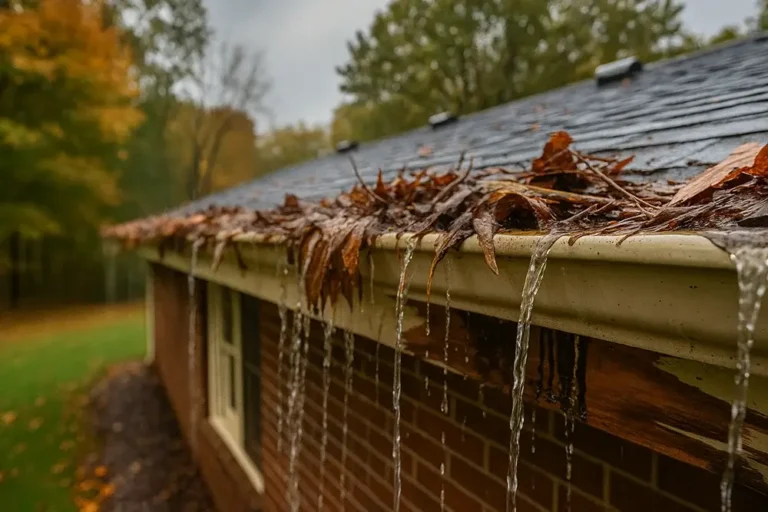
The decision to repair versus replace should be based on the “Granule Threshold.” If more than 30% of the asphalt granules are in the gutters, the UV protection is gone, and repairs will be brittle and prone to failure. In this case, a surgical repair is only a “buy-time” strategy, not a long-term budget solution.
Detailed Real-World Scenarios
Scenario A: The Chimney Flashing Failure
A homeowner notices a leak around the hearth after a heavy wind-driven rain.
-
The Plan: Rather than replacing the whole roof, the focus is on a “counter-flashing” reset. This involves grinding a reglet into the brick and tucking new metal flashing into the joint.
-
Failure Mode: Using “caulk only” as a budget fix. UV light will shrink the caulk within 18 months, leading to a recurring leak.
Scenario B: The “Aged but Stable” System
The roof is 18 years old (of a 25-year rating) and has no leaks but shows minor curling.
-
The Plan: A budget-conscious “Tune-Up.” This includes replacing all rubber pipe boots (which usually fail at 10 years) and securing loose shingles with roofing cement.
-
Outcome: Preventing the “surprise” leak that usually leads to emergency, high-cost repairs during storm season.
Planning, Cost, and Resource Dynamics
The economics of a roof repair are driven by “accessibility” and “slope.”
| Budget Factor | Impact on Cost | Mitigation Strategy |
| Pitch (Steepness) | High (Safety equipment) | Schedule during periods of dry, cool weather. |
| Waste Disposal | Moderate | Sort and recycle metal components independently. |
| Permitting | Low/Moderate | Verify if “minor repairs” require a permit in your jurisdiction. |
The Opportunity Cost of Delay: A $500 flashing repair neglected today becomes a $5,000 interior mold remediation and drywall project tomorrow. In the context of how to plan roof repair on a budget, “zero-cost” inaction is actually the most expensive choice available.
Tools, Strategies, and Support Systems
A successful budget repair relies on high-quality “interceptors”:
-
Self-Adhered Ice and Water Shield: Used in valleys and at the eaves; it is the most important “hidden” cost that should never be skipped.
-
Step Flashing: Individual L-shaped metal pieces for wall-to-roof transitions.
-
Roofing Cement (Mastic): The “emergency kit” for stop-gap measures.
-
Infrared Thermography: A tool to detect damp insulation under the roof deck without removing shingles.
-
Kick-out Flashing: A small but critical diverter that prevents roof-to-wall water from entering the siding.
-
Zinc or Copper Strips: An inexpensive “passive” repair for roofs prone to moss and algae, which can trap moisture and rot shingles.
Risk Landscape: Compounding Failures
The primary risk in budget roofing is “Blind Rot.” This occurs when a repair stops the liquid water but the system remains “vapor-closed,” allowing condensation to rot the rafters.
-
Compounding Risk: The “Shingle Overlay.” While it saves on labor (no tear-off), it traps heat, adds massive weight to the structure, and prevents a proper inspection of the deck.
-
Taxonomy of Errors:
-
Procedural: Nailing in the wrong location (high-nailing) which voids the wind warranty.
-
Chemical: Mixing incompatible metals (e.g., aluminum flashing with copper-treated wood), causing galvanic corrosion.
-
Governance, Maintenance, and Long-Term Adaptation
A roof requires an “inspection governance” model.
-
The Annual Binocular Review: Every fall, inspect the roof from the ground with binoculars. Look for “shingle pops” or debris in the valleys.
-
The “Clearance” Protocol: Ensure all tree limbs are at least 6 feet away from the roof to prevent mechanical abrasion and squirrel access.
-
Documentation: Keep a physical record of the shingle manufacturer and color code. In a budget repair, “matching” the existing shingles is the difference between a seamless patch and a localized eyesore.
Measurement, Tracking, and Evaluation
How do you know if your budget plan was successful?
-
Leading Indicator: The “Drying Rate.” After a rain, the roof surface should dry uniformly. “Dark spots” indicate water trapped under shingles.
-
Lagging Indicator: The absence of “thermal bridging” (snow melting in specific patterns on the roof) which indicates heat is escaping from the attic and degrading the roof system.
-
Documentation: Photos of the repair before the final shingles are laid to prove to future buyers that the flashing and underlayment were handled correctly.
Common Misconceptions and Oversimplifications
-
Myth: “A leak always means I need a new roof.”
-
Correction: 90% of leaks are related to flashing, not the shingles themselves.
-
Myth: “Metal roofs are only for high-end homes.”
-
Correction: On a lifecycle basis, a budget-tier metal roof can be cheaper than two asphalt roof cycles.
-
Myth: “I should caulk the bottom of my windows and doors.”
-
Correction: In roofing, you must always leave “weep holes” or exit paths for water. Caulking the “exit” point of a flashing system will force water into the house.
Conclusion
The successful execution of how to plan roof repair on a budget is an exercise in technical prioritization. It requires the homeowner to act as a project manager who understands the difference between an aesthetic flaw and a structural threat. By focusing on the transitions, ensuring the attic can breathe, and intervening before the decay curve becomes exponential, a property owner can maintain a dry, safe structure without a total capital collapse. The goal is a roof that remains “boring”—a silent, functioning asset that protects the home’s equity through the strategic application of building science and fiscal discipline.